
Concept Paper
Applied Enterprise AI
From Digitization to Cognification
Using AI Is Only the Beginning
AI adoption has already started inside enterprises.
Employees are using ChatGPT, Claude and other AI assistants to write, research, summarize, analyse and solve problems. Some employees are becoming remarkably effective at applying AI to their own work.
That itself is a form of Cognification.
A capable employee may already know what information to collect, what context to provide, how to work with AI, how to validate the output and what to do next. AI has changed how that individual gets the work done.
But if this capability depends on one employee knowing all of this, it remains largely with that employee. The organization has not yet captured it in the way the work operates.
The next step is to take what works at the individual level and embed it into the process — with the right context, enterprise knowledge, systems, tools, controls and human involvement.
Cognification can begin with a person. It becomes an enterprise capability when it becomes part of how the work gets done.
So instead of only asking:
Are we using AI?
we should also ask:
Where should AI become part of how our work gets done?
The Inflection Point
For the last few decades, enterprises have focused on digitization.
ERP, CRM, HRMS, accounting software, HMIS and other enterprise systems moved information, transactions and processes into software. They became systems of record and brought structure, standardization and control to how organizations operate.
But even after digitization, people still do a lot of work around these systems.
They interpret information, investigate exceptions, reconcile differences, prepare analysis, coordinate across systems and decide what should happen next.
That is not a failure of digitization. Much of this work simply could not be expressed as predefined rules.
At the same time, the nature of enterprise work has changed.
Though people today have access to far better systems, information and communication than earlier generations, their time and attention are increasingly fragmented across applications, messages, meetings, dashboards, documents, notifications and continuous requests.
At one end, mundane and repetitive work continues to consume human attention even when the work itself does not deserve that much attention.
At the other end, deep analytical work needs time, focus and the ability to process large amounts of information — something increasingly difficult for individuals to do consistently at enterprise scale.
Human attention itself has become a scarce enterprise resource.
AI arrives at this point with a very different capability.
It can read, understand, interpret, analyse, communicate, monitor and work with changing context. Predictive models can analyse patterns and estimate outcomes at a scale that people cannot practically do manually.
Enterprises can now start deciding which cognitive work should continue to be done by people, which work AI can relieve them from, and where AI can actively extend human capability.
This is the move from Digitization to Cognification.
What is Cognification?
Cognification is the art of augmenting people with AI.
At one end, AI can relieve people from mundane and repetitive work that still needs some level of understanding, interpretation or judgment.
At the other end, AI can actively assist people with deeper analysis, prediction and large volumes of information that are difficult to handle manually.
There is an important distinction between traditional Automation and Cognification.
Automation
Automation works best when the rules and next actions can largely be predefined.
If this happens, do that.
The system follows a deterministic path.
Cognification
Cognification comes into play when the input, context, interpretation or next action can change.
Traditional software is excellent when the rules are known.
Cognification extends what software can do into work involving language, ambiguity, changing context, analysis and prediction.
Relieve people from the mundane. Augment them for the complex. That is Cognification.
Start With Work, Not AI
I believe enterprises are asking the wrong starting question when they ask:
Where can we use AI?
That question immediately takes the discussion towards models, products, vendors and technology.
The better question is:
What work does your team struggle with or hate doing, but still has to do despite being 100% digitized?
This does not mean looking at everything people do and asking whether an AI Agent can replace it.
The purpose is to identify two kinds of opportunity.
First, work that happens repeatedly, consumes human time and still requires enough understanding or context that traditional automation could not handle it well.
Second, work where people need deeper analytical capability — because the volume of data, number of variables or need for continuous analysis makes it difficult to do effectively through human effort alone.
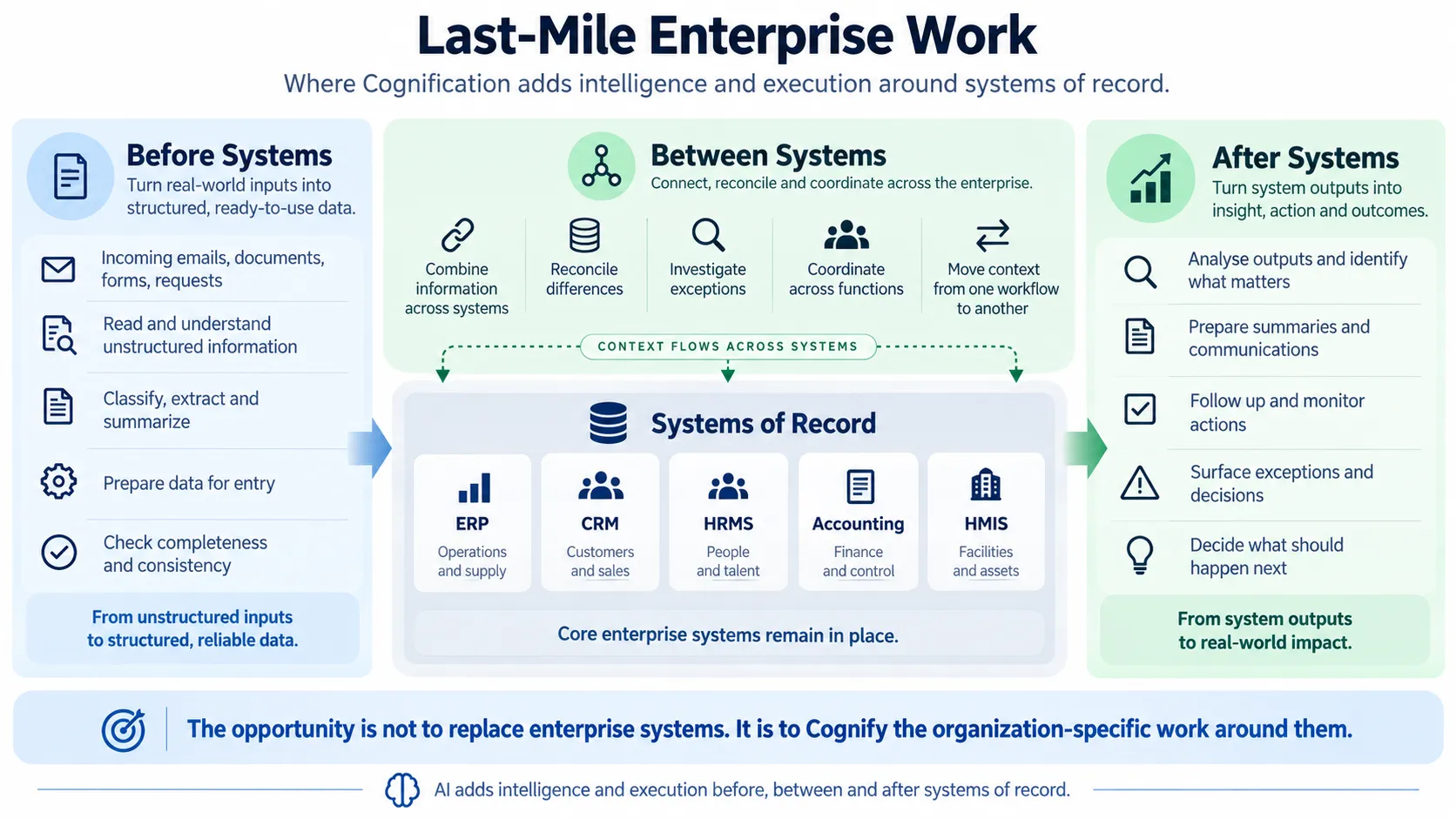
A lot of this opportunity exists in the last mile around enterprise systems.
ERP, CRM, HRMS, HMIS and other systems of record may already be doing exactly what they were designed to do. But organization-specific work still happens before them, between them and after them.
A finance team, for example, may still need to combine information from multiple systems, investigate differences, interpret what matters and prepare an analysis for action.
The opportunity is not to replace the ERP.
It is to Cognify the work around it.
The opportunity has to be discovered from the work, not from the technology.
The Spectrum of Work
A useful way to think about Cognification is as a spectrum.
The exact mix will be different for every role, department and organization.
~20% — Relieve
At one end is mundane cognitive work.
This is work that consumes human time but does not necessarily require sustained human involvement.
AI can increasingly take on parts of this work, especially where some understanding of language, documents, context or exceptions is required.
Objective: Reduce unnecessary human effort.
~60% — Human-Led Core Work
The middle remains primarily human-led.
People bring domain knowledge, relationships, accountability, judgment, creativity and understanding of business outcomes.
AI may still assist, but the person remains central to the work.
~20% — Augment
At the other end is work requiring deeper analysis, prediction or the ability to work across large amounts of information.
AI can analyse more information, identify patterns, continuously monitor signals, run predictive models and bring relevant insight to the person making the decision.
The objective here is not to remove the person.
It is to expand what the person is capable of doing.
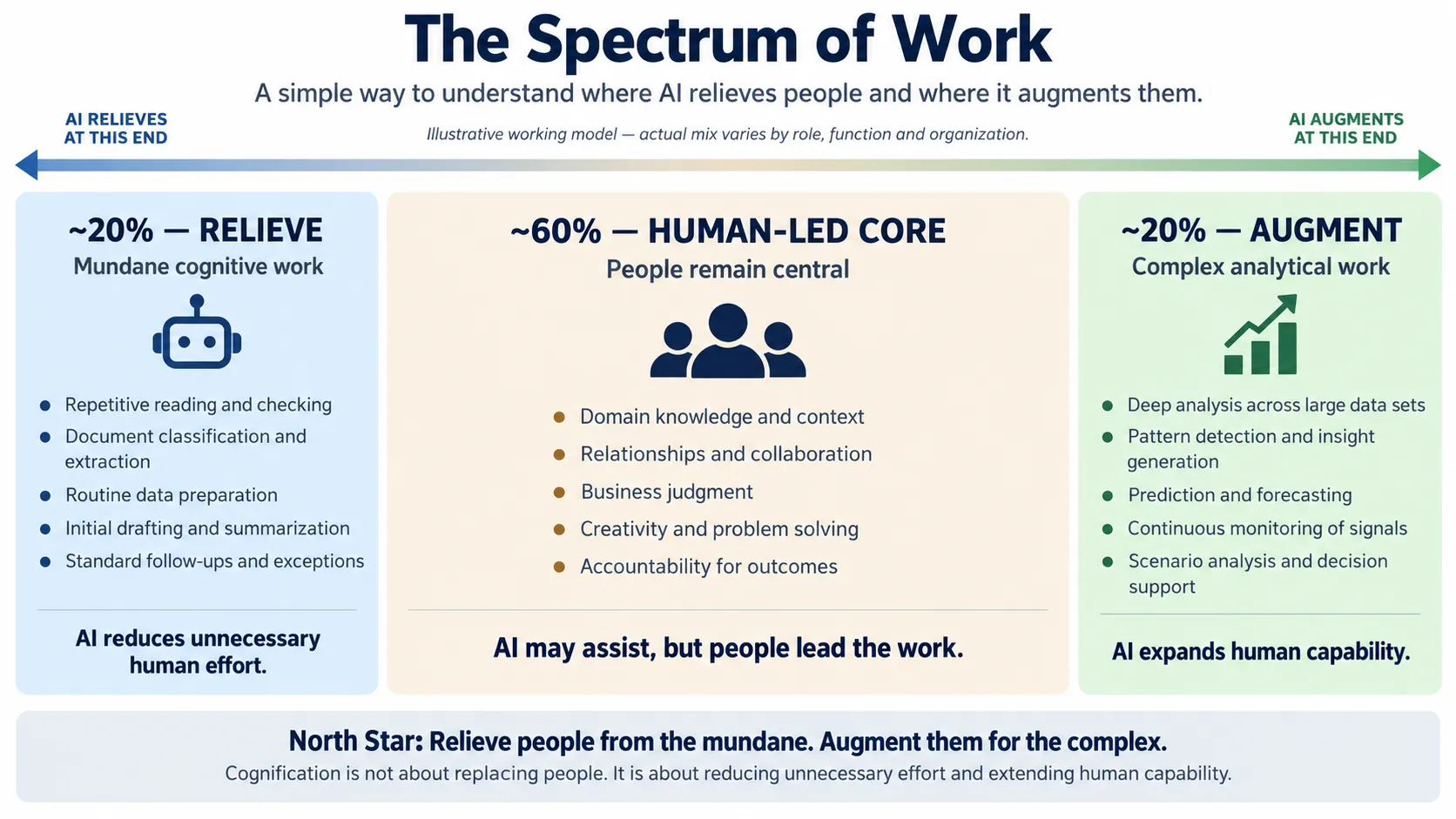
Note: The proportions are an illustrative working model. The actual mix varies by role, function and organization.
So the North Star is not:
How much work can AI replace?
It is:
Where can AI relieve people, and where can AI make people more capable?
How Enterprise AI Actually Works
Once the work is identified, the next question is practical:
What actually makes AI capable of doing this work?
Enterprise AI is not one technology.
It is a combination of intelligence, knowledge, tools, connections, coordination and controls working together.
I use an automobile and human analogy because it makes these components easier to understand without hiding the underlying architecture.
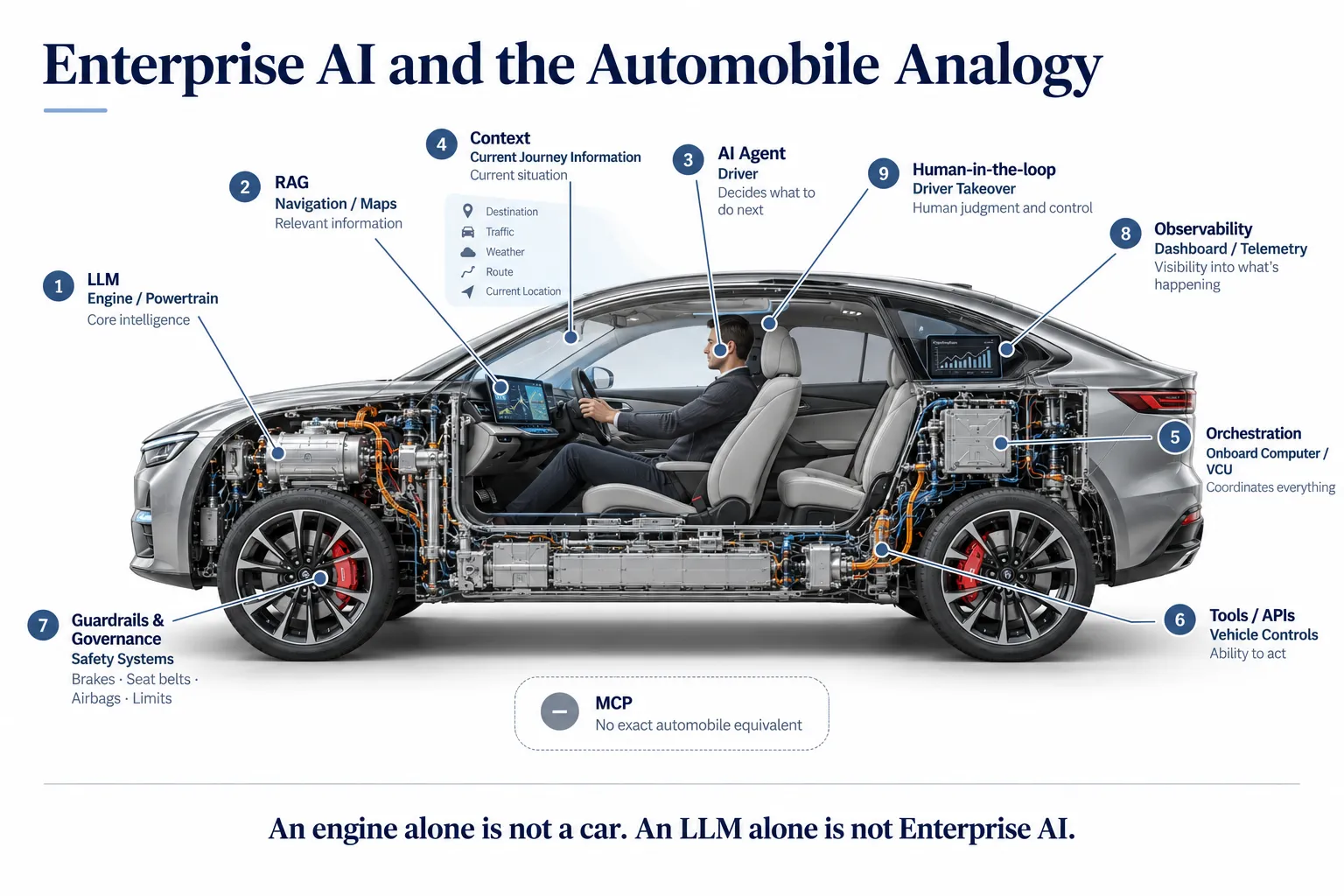
| AI Component | Automobile | Human |
|---|---|---|
| LLM | Engine | Brain |
| RAG | Navigation / Maps | Recall / Looking something up |
| AI Agent | Driver | Person / Worker |
| Tools / APIs | Vehicle controls | Hands, legs, voice |
| MCP | No exact equivalent | No exact equivalent |
| Orchestration | Onboard computer / Vehicle Control Unit | Nervous system / executive coordination |
| Context | Current journey information | Working memory |
| Guardrails | Safety systems | Inhibitions / reflexes |
| Observability | Dashboard / telemetry | Senses / self-monitoring |
| Human-in-the-loop | Driver takeover | Conscious human judgment |
LLM
A Large Language Model provides the language intelligence.
It can understand, interpret, reason over information and generate responses.
But an LLM by itself is not an Enterprise AI solution.
Just as an engine alone does not make a car, the LLM needs other components around it to perform useful business work.
RAG
RAG allows an AI system to retrieve relevant information when it needs it.
That may be a company policy, customer record, procedure, contract, product document or other enterprise knowledge.
It is similar to using navigation or looking something up before deciding what to do.
AI Agent
An AI Agent is closer to the driver.
It is given an objective and can determine what to do next using the intelligence, information and tools available to it.
The model provides intelligence. The Agent puts that intelligence to work.
Tools and APIs
Tools and APIs give the Agent the ability to interact with other systems.
It may retrieve CRM information, update ERP, search a database, create a ticket or send a communication.
Without tools, an Agent may understand what needs to happen but cannot do much outside the model.
MCP
There is no exact automobile or human equivalent for MCP.
A crude analogy is a car arriving at a charging station.
Imagine the charging station can tell the car what capabilities it provides, whether it is compatible, what charging speed is available and how charging can be started.
The charging station does not decide whether the car should charge. The car's intelligence decides that.
MCP similarly provides a common way for AI applications to discover and use tools, data and capabilities exposed by other systems.
Orchestration
A modern vehicle has an engine, transmission, sensors, brakes and many other systems. They need to work together.
The onboard computer or Vehicle Control Unit helps coordinate them.
Enterprise AI has the same requirement.
Models, Agents, tools, workflows, enterprise systems and human approvals need to work together.
Orchestration determines what happens first, what happens next, which capability should be used and where human involvement is required.
Guardrails, Governance and Observability
A powerful automobile also needs safety systems and monitoring.
Enterprise AI needs the same.
What can an Agent access?
What actions is it allowed to perform?
Where is approval required?
What happens when it is uncertain?
Can its actions be traced?
Who remains accountable?
Enterprise AI is therefore not one LLM or one Agent.
It is the complete system required to apply intelligence safely to business work.
The AI Execution Layer
Traditional enterprise work normally looks something like this:
Human → Enterprise Applications / Workflows → Systems of Record
The employee interprets information, decides what needs to happen and uses applications or workflows to perform the action.
With AI, another operating model becomes possible:
Human → AI Agent / Workflow → Enterprise Applications / Systems of Record
AI can increasingly retrieve permitted information, interpret context, perform delegated actions and coordinate work across existing enterprise systems.
Three Ways Enterprises Are Adopting AI
I see enterprise AI adoption broadly happening in three forms.
Personal AI
Employees use tools such as ChatGPT, Claude, Copilot or other assistants while doing their work.
The person drives the process. AI assists the person.
As discussed earlier, a capable employee can already Cognify parts of their own work this way. The limitation is that the capability may remain dependent on that individual.
Product-Embedded AI
AI capabilities are built into CRM, ERP, service-management and other enterprise applications.
The existing product becomes more intelligent, but the capability largely remains within that product.
Applied / Process AI
AI becomes part of the business process itself.
It can be connected to enterprise knowledge, tools, workflows and systems, allowing it to interpret context, participate in execution and involve people where necessary.
This is where Applied Enterprise AI becomes particularly important.
The systems of record do not disappear.
Existing workflows do not disappear either.
AI becomes another execution capability around them.
This is where individual Cognification can become repeatable enterprise capability.
From Assistance to Delegation
This does not mean every process should immediately become autonomous.
The level of delegation should depend on the work, reliability and risk.
Assist → Execute With Approval → Execute by Default → Bounded Autonomy
For some work, AI may only analyse and recommend.
For other work, it may execute but require human approval.
For well-understood, lower-risk work, more execution may eventually happen without constant human involvement.
The principle remains:
AI can perform the work. Humans still own the outcome.
Business functions define the work, desired result and boundaries.
Technology provides the architecture, integrations, permissions, security and controls required to make that delegation safe.
Making the Business Case for AI
The business case for AI should not be reduced to headcount reduction.
The real question is how organizations will increase productivity when human time and attention are already constrained.
The service itself may remain the same.
A hospital will still provide healthcare.
A bank will still provide banking.
A finance team will still close books.
A sales team will still manage customers.
But the way those services are delivered does not have to remain the same.
Organizations increasingly expect faster turnaround, deeper analysis, better decisions, better customer experience and more output from the same available time.
There is a limit to how much of that improvement can come from asking people to work faster or adding another software application.
The operating method has to change.
For many years, productivity improvement meant giving people better software to perform their work.
The next step is also to decide which parts of the work people should no longer have to perform themselves — and where AI can give them capabilities they did not previously have.
Instead of only asking:
How can this employee do this work faster?
Ask two questions:
What part of this work should the employee no longer have to do?
and
What could this employee do better if AI actively assisted them?
That is the business case for Cognification.
The Cognified Enterprise
A Cognified Enterprise is not one where AI replaces people.
It is one where work is deliberately divided between people, software and AI based on what each does best.
AI relieves people from cognitive work that does not deserve their time and augments them where machine capability can extend human capability.
This creates another important change in the workplace.
The next workplace skill is not simply knowing how to use AI. It is knowing where and how to apply AI in your own work.
The same AI can produce very different outcomes in different hands.
Give everyone the same car and the outcome still depends on how well they know how to drive it.
AI will be similar.
People will need to learn what to delegate, where AI should actively assist, where human judgment is required and how to combine human and machine capability effectively.
Over time, access to powerful models, Agents and AI tools will become increasingly common.
The difference will be in how well an organization understands what to Cognify, how to Cognify it and how well its people work with AI.
That is where the advantage will come from.
Principles of Cognification
Start with work, not AI.
The opportunity should be discovered from business work, not from a technology looking for a use case.
Relieve the mundane. Augment the complex.
Use AI to reduce cognitive work that does not deserve continuous human attention and to extend people where machine capability can make them more capable.
Work with existing enterprise systems.
ERP, CRM, HRMS, HMIS and other systems of record remain important. Cognification adds intelligence and execution around them.
Humans remain accountable for outcomes.
Delegating work to AI does not delegate organizational responsibility.
Increase delegation when reliability and risk justify it.
Not every process needs autonomy. The appropriate level of AI involvement depends on the nature of the work, consequences of failure and confidence in the system.
References
The Cognification work spectrum presented in this paper is an illustrative model, not a claim that every occupation contains exactly 20% mundane work, 60% human-led work and 20% deep analytical work.
Research nevertheless supports the broader direction: generative AI has different effects across tasks and occupations, with substantial potential both to automate portions of routine cognitive work and to augment human performance in knowledge-intensive work.
References for further reading:
- World Economic Forum — Jobs of Tomorrow: Large Language Models and Jobs
- World Economic Forum — Future of Jobs Report 2025
- International Labour Organization — Generative AI and Jobs: A Refined Global Index of Occupational Exposure
- Harvard Business School / Boston Consulting Group — Navigating the Jagged Technological Frontier
- Anthropic Economic Index — research on real-world patterns of AI augmentation and automation